3rd Quarter is a Wrap

The third quarter is in the books. I tried a lot of new things this quarter and I have say, by and large, I am glad of it. The biggest changes started as a result of a conversation I had earlier in the year about why I didn’t have standards of the day posted. My principal was showing a new district admin around the campus and they stopped in my room. I answered that standards of the day don’t work really well when the students are all over the place in terms of what they are doing and learning. Some have been in my class for a week and others for a year or more. So he asked if that meant they all had individual daily standards of the day because “that would be pretty cool.”

Yea, it would. 

I have long wanted to be able to work with each student to create an individual learning plan. Instead of me telling them each day what to do, why can’t we – the student and I- create a plan for where the student wants to go in the year? Its a pretty daunting task when you really think about it, sitting down with each student, each day, and talk about what they are doing and what they need to keep going. But I realized it is not too tremendously different than what I was already doing. Some kids were working on self designed projects, some were working on basic projects I had given them, and still others were working on special projects for other people, like what happens in a job. So I thought, what the heck, go for it.

I decided that I would, as much as possible, talk with each student each day about what they were working on, and develop a plan for what is next. Sometimes that would mean what they were doing today, but other times the talk was what was going to happen tomorrow. So far it is working pretty well. It is shifting responsibility for what is happening in the room from me to the students. They don’t come in and wait for me to tell them what to do, they already know what they need to do. They may not know how- that might be their daily goal, figure out how to accomplish something- but they know what they need to do.

The grade book was the scary part for me. How could I keep a grade book if everyone was truly doing something different? The answer was simple; don’t keep the grade book.  As Alice Keeler would say, let it go! The final assignment for the quarter was for students to tell me what they learned, and provide evidence. If I was going to see it all in one sitting, and I was going to sit down with each student each day, why did I need to keep entering numbers in a spreadsheet? I didn’t need to. I was giving them verbal feedback each day, that was better than a number or a grade. What really surprised me was not only did very few students seem to notice the grade book was empty  but many students asked if it would be OK if they could redo this or that and show it to me tomorrow when it was better.

Um, yea, that would be good.
What Are We Doing Today?

You would think that after eighteen years in the classroom I would really be zeroed in on what my curriculum is going to be one year to the next. You might think I have this big file cabinet full of project outlines, or binders full of project ideas. When I started teaching all those years ago I thought that was where I was going.  I bought binders, lots of them, so I could save student projects one year to the next so students would have exemplars; students could see what a good project looks like. I was told a good teacher knows where the class is going, and has a clear roadmap, or curricular plan, on how to get there. A good teacher has a binder with all of the assignments for the year. Students will do this, then that, then the next. A good teacher plans each detail of the year. Thats what I was taught.

So what happened? Where’s the binder?

Well, technology happened. It would be absurd for me to ask my students to do the same things I was asking them to do just 5 years ago. The things they were doing  and spending a week on can now be done in five minutes with any number of apps on their cell phones. What was impressive and engaging for students a couple years ago is old hat now. So I have to take risks. I have to try this, and try that. Some things just don’t work either technologically, or I can’t capture kids interest. Other things work. They engage kids. I don’t know from one week to the next what is going to really click, or from one kid to the next. The heck with two or three years down the road!

A tweet caught my eye the other day-

I usually do not know where my students are going with their work in class. I have no idea what form their “projects” are going to take a month from now. I will show them a tool, suggest some kind of topic, provide an example, and challenge them to use the tool. Yes it is a standards based class, but that doesn’t mean everyone is doing the same, preplanned thing at the same time. They aren’t. We are figuring it out together as we go. Some times it works, and sometimes it doesn’t work so well. But I am really glad I don’t have those binders that used to seem so important.

Where is my chair?

A couple of years ago I got rid of my classroom desk. I overheard a student talking about a teacher, saying that “teacher just sits there behind the desk all day…” I didn’t know if they were talking about me or not. I knew that they could be.  I knew that I spent a lot of time at my desk, especially after lunch. I was tired and wanted to sit down. I realized more often than not students came to me with questions instead of the other way around. I tried to resist the urge to sit at the desk, but I kept finding myself there, sitting at the desk. So I got rid of it. If I didn’t have a desk no one could say I just sat at it!

In the process of getting rid of the desk I totally redesigned the room into what I think of now as a maker space. (At the time I hadn’t heard the term.) Student computer work stations around the perimeter of the room and work tables in the middle. It worked great for a while. I was on my feet walking the room all day. Yes I was tired at the end of the day, but the improved interactions with kids made it worth it.

When we came back from winter break I found a new chair in the room. My principal got me a new “draftsman chair” so that I could sit at the big work tables. Bless his heart. He went out of his way to get this chair just for me, so I sat in it. A lot. I soon found that one of the large work tables became my desk, and I sat there, a lot. Again.

Don’t get me wrong, I need a workstation. I have to take attendance on a computer, and the tablets I have access to don’t work so well for that.  I have to have a computer to demonstrate what the students are supposed to be learning, and that computer has to be somewhere. So that spot becomes a work station. I need to keep reminding myself it is a workstation, not a Mark station.

So the nice new chair is now sitting in the corner of the room by the sink. I found it makes a nice coat rack. I need to keep walking the room.

About those quizes…

Yesterday we held our annual SkillsUSA Regional Competition. For those that don’t know, SkillsUSA is a national student led career and technical organization. Students compete in career or leadership related events. Welding students, for example, are presented with materials and drawings and asked to produce the piece depicted in the drawing. Leadership students might present their student designed and implemented community service project. It is, I believe, a fantastic way to assess what students are learning in the classroom. Which brings me to the point of my blogpost this morning.
The Washington Post this morning ran a story by Valerie Strauss called “How we teach kids to cheat on tests.” The story does a pretty good job of summarizing what happens when we put too much importance on the test score, or the quiz score.

This morning Daniel Ching  @danielpching published a blog post “The importance of process” in which he talks about the importance of providing feedback throughout the process of learning, and grading that process.  Too often we educators put all of the grade on the final test, and the students loose out as a result.

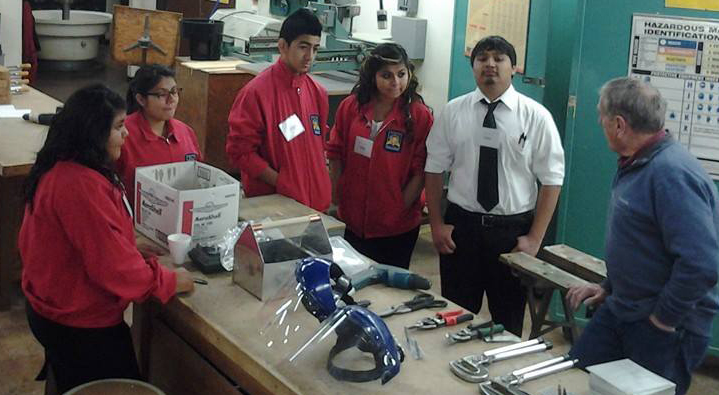
So lets go back to the SkillsUSA event yesterday. I was asked to run the Quiz Bowl event. This is sort of a “Jeopardy” type event where students, working in teams of 5, are asked a variety of questions. Questions include basic math, geometry, science, world and national politics, current events, and career related questions. It was fascinating for me to watch how students solved problems. Yea there were obscure questions where everyone in the room threw up there hands and said “whats a minority whip?” They were 10th and 11th graders after all. But for other questions it was interesting to me to watch the students break off into twos and threes and come up with their own answers,  talk their way through the questions, and come to an agreement on the answer. I could easily see strengths and weaknesses for each student. More importantly the students could see their own strengths and weaknesses. They were arguing for their answers, and providing  evidence to support those answers.

Photo by David Varela. Used with permission.

I learned much more about what these students knew by standing in the room and listening to them talk to each other than I ever would learn from the results of a test. Just as I learn more about what my students know by listening to them as they prepare for their presentations.

My students typically participate in the Career Pathways Showcase. In this event they prepare a presentation where they demonstrate what they have learned. On Friday a group of students was preparing their presentation and one of them said “We should bring the books we read as evidence of  our learning. We could talk about the books.” Another group decided to bring a stack of their mistakes, and talk about what they learned from them. I didn’t tell them to do these things, they decided it was the best way to demonstrate their learning.

I think these SkillsUSA events are much better assessments of student learning than any test. So no, there is not going to be a quiz on this on Friday.

Vocabulary

The topic of teaching vocabulary has been coming up a lot in my circles lately. The conversation goes like this:

Teacher: “These kids need to get motivated. If they don’t want to try I can’t do it for them.”

Me: “Well, what are you asking them to do that they aren’t doing?”

Teacher: “Like vocabulary. We have to do vocabulary, they can’t learn the concept if they don’t know the terms. But they aren’t learning the words. I just don’t know what else to do.”

There are some assumptions in this dialog, and I suggest they are  false assumptions. The first assumption is that we have to “do vocabulary.” I don’t think I know a single teacher or student who enjoys the activity of writing a word, looking up the definition, putting it in a sentence and whatever else ritual is tacked on to this exercise. Nor can I find many people who can honestly claim that is a particularly effective  exercise. Yes, students do it, but there doesn’t seem to be a lot of evidence that any real learning is taking place. But so many continue to inflict this exercise on their students, because, well, we have to. Why do we have to? Because thats the way our teachers did it way back in the day? I sure didn’t get a lot out of it in those days, did you? Maybe we do it because the textbook or pacing guide says we should. Or because that is the way it is done in the department/grade level/school district. I suppose that may be the issue in some cases, but if it is, it should be questioned.

The second assumption is that they can’t learn the concept if they don’t know the terms. Really? I understood the basics of fire behavior long before I understood that fire is rapid oxidation generating light, heat, and smoke. I learned a long time ago that fire is hot, and it burns. I didn’t have to write a synonym, or use it in a sentence a single time. I learned by experience that if you take away the heat by putting water on the fire it will go out. I learned that if you take away the oxygen it will go out. I learned these things long before I heard of the fire tetrahedron.

I guess what I want to say to these folks who are recognizing that what they are doing  isn’t working is that maybe they should try something different. You can’t wait for “the kids to get motivated.” Maybe one day all of the  students in your room will magically be highly motivated, but probably not. Maybe there will be this mysterious shift and your school will be full of  academic high achievers, but probably not. Most likely, if there is going to be a change, the change will come from the teacher, not the students.

So if you are one of those teachers struggling with things not working, change something. Learn how to do it differently. Don’t know how? There are lots of places to learn. Twitter is full of awesome teachers who are full of ideas, and there are lots of web sites out there to teach you how to use Twitter. Google  “Twitter for Teachers.”

Social Media is not your thing you say? Buy a book. There are many, many great books out there to help you look at things differently. My recent favorite is Teach Like A Pirate by Dave Burgess. But thats just me. Amazon is full of great titles. Get some and read them. And then implement some of the things you read.

There are lots of conferences and workshops out there as well. Yea some of them are expensive and require a huge time commitment, but many are just a weekend morning, or are a single afternoon and don’t cost much.

My bottom line is if things are not working well, try doing it differently. Take a risk and admit it could be better. That is the first step to doing it better. If what you are doing isn’t working well, don’t keep doing it. Do something different.

The Daily Objective

I had a couple administrators walk through my classroom the other day. It was no big deal, the principal was just showing her new boss around. We chatted. It was nice. Then I was asked why my daily objectives were not posted anywhere. I gave my standard answer; after about a month into the school year most kids are in totally different places in the curriculum. How can I have one objective when I have a room full of people all doing different things? In the past visitors would accept this answer and move on to something else.

But this time there was a followup question. “Does that mean that all of the students develop their own daily objectives?” I never had a follow up question before. I think I actually stammered in my response. I said something about the advanced kids are supposed to make weekly objectives and if I was better at what I do they would do a better job of it.

I have never really given a lot of thought to each student having a different daily objective. I think it would be a really, really good thing to do, but I don’t have any idea how to make it actually make it work. I can’t talk with each student each day to develop an objective; by the time I got half way around the room the period would be over. But I am thinking I could do a Google form, or a Doctopus page, where each day at the start of the day the student writes down, first thing, what the objective is for the week and the day. That way each student is working on a clear measurable objective. And they know what it is.

I would love to hear other ideas on how I can do this.

Being proud and actually saying it.

I was able to attend Fall Cue this year again.  It was, as usual, a great experience. It was a little different this year in that I didn’t come home with a great new tool. Usually I learn of a great tool that is new to me; an app, a web site, or a gadget. This year there was no such discovery for me. The learning for me seemed to center on attitude. Mostly my own. I really wanted to refine my thinking about the maker concept and design thinking, and I was able to do that, but it wasn’t really new.

The opening keynote by Ramsey Mussalum, which can be seen here, was great. Does Ramsey do anything not great? (Why do they call it the opening keynote when it is delivered at the midway point of the conference? But that is an aside.) Ramsey talked about why so many kids hate school, and to combat that we, as teachers, need to love our jobs. If you don’t love your job it shows, and you make it all the more likely that your students will #hateschool. Fortunately, #Ilovemyjob.

The closing keynote by Angela Maiers was equally powerful. She talked about how kids just want to be acknowledged and valued. Call them by their name Angela said. All of them. Make them know you notice them. In a good way.

One of the reasons #Ilovemyjob is because I work at a small school where I can know every kid’s name. We have less than 250 kids. I need to do better about knowing all of their names, even those who don’t hang out in Awesomnesity Central, or for those who don’t know, Room 17. I came back to school with the plan that I was going to seek out those kids who think #Ihateschool and say hello to them, by name. It seemed simple enough, and sounded like a pretty good idea.

It was Tuesday afternoon, the last period of the day. I spent most of the day honestly amazed at the work my students were doing. We were doing some pretty complicated GIS stuff on a school network that doesn’t like GIS stuff. We had lots of issues, and the kids were just plowing right through them. They were almost finished with a project and I was just beaming with pride. I said it.

“You guys are really doing amazing work, sticking to it, working through problems. Its amazing to watch. I am proud of you.”

One girl turned around and asked “Me? You are proud of me too?

“Yea, you. Everyone in here. You guys are doing amazing stuff.”

“But you mean me? You are proud of me?”

“Yea. Of course. Your data was gone, you got it back, like it was no big deal. You have been doing great work. Why are you acting surprised?”

“Because no one has ever said that to me.” Long pause. “No, no one. No one has ever said they were proud of me.”

I am glad I went to Fall Cue.

Is it Good Enough?

Something different is happening in my classroom this year. To start with my students are moving along faster, doing much more complicated work than I have ever had happen before. They are working through difficult technical issues with good, positive attitudes. Lots of “well that didn’t work, lets try this” types of things are happening. One afternoon a kid yelled out, with his arms raised in triumph “Yes, our point data is displaying right, we did it!” As he finished the sentence the bell rang and he said “Dang, I still need to make a layer package!” It was fun to watch. In past years many kids would have given up, and I would spend lots of time trying to coax them into continuing. But its different this year.

I think part of the reason for the difference is I have made a deliberate effort this year to “encourage kids to fail.” Not fail as in flunk, but to take risks. I tell them they are supposed to mess up- that’s why we call it school. I dare them to break the software. I remind them to save often, but don’t be afraid to push buttons and see what happens. If something breaks don’t push that button next time. And if you figure it out (we even have a song “figure it out”) don’t be stingy, show someone else. If you can’t figure it out, ask someone who did.

I find myself sitting in the corner of the room many days just watching and smiling. Its busy. Its noisy. And its a bit messy. Often times every student is working on something different, no two screens look alike. Its awesome. Lately kids have been asking if they can do a project over because “mine came out boo boo. I need to fix this and that.” In years past they would have just said it was “good enough.” But my favorite comment so far this year was the girl who said “Hey Mr. Hall, come over here. Its time you learned how to do this too. Sit down right here, I am going to teach you how.”

Yea, About That Charter School Thing.

Let me start by saying that I have never actually worked in a charter school. I have spent my whole career in public schools in high poverty urban settings. I have always spoken out against the charter school concept. It appeared to me that they cherry pick kids. If they don’t get to pick the kids they take, because of a lottery system, they get to pick the kids they keep, through a variety of ways. They are a threat to public education. That’s what I thought.

But lately more and more the schools that I see as doing things right are charters, or at least these schools have a charter component. Locally there is the Venture Academy. It is in the same extended neighborhood as the school in which I work, so it is convenient to my students. It is close enough that untill this year they used our gym for their after school sports program. My school looses a number of kids each year to this school. We rarely get kids that come to us from the Venture Academy. I don’t wonder why.

Yesterday I attended an edtech conference at Natomas Charter School in Sacramento, California. While I have much less experience with this school, it was evident from walking the campus, sitting in the rooms, and talking to some of the teachers who work there that they are doing a lot of things right. They aren’t cherry picking kids, and from everything I can see, they aren’t kicking kids out. They seem to be doing really great things in the classrooms.

I frequently ask my PLN on Twitter to recommend schools I can visit. The recommendations that come back are always charter schools. I have yet to have a person recommend to me an awesome public high school that is not a charter. Why is it that no one can recommend to me a public high school that serves a high poverty population that isn’t a charter? These charters must be doing something right.

So I am officially saying it. I was wro… I was wrrooon… Dang it, I was wrong. There I said it. I was wrong about charters. They arent a threat to public education. They are one of the few promises of public education. They have to compete for students, so they have to do a good job, or they can’t stay open. Because they have to compete, they can’t just do the same old, same old. They have to purposely do things to compete, to keep up. They have to keep up with the times, the technology, and the community.  And that is why I have changed my mind about charter schools. There. I said it.

Mom’s on the phone

mobile phones
mobile phones (Photo credit: phossil)

This year our school district changed a policy concerning cell phones used by students. While there seems to be some contradictions, my understanding is that it is ok for students to have and use cell phones on campus, as long as they do not disrupt instruction. While some teachers are still taking phones from kids I decided to try something new. I gave them an assignment and encouraged them to use their phones to do it. Then I told them it was ok to use their phones as long as they were not just texting, Instagraming, Facebooking, or what have you. I promised them I would not give them grief about their phones, if they kept it professional.

So far it has worked out well. Almost everyone has a phone, iPod, or tablet out and plugged in. They have their ear buds in while they are working, they take them out when I need to talk to the class. They take pictures of things they need to remember. They step outside to make audio recordings, and they compare apps for given tasks. And yes, they text. Every now and then I will see someone talking on the phone.  I tell myself it is ok. I asked a student who she was talking to on the phone. She said “My mom called.”

Yesterday I asked a girl if she thought she might be texting too much. She didn’t argue with me at all. She said “You’re right.” She turned to her friend next to her, handed her phone to the friend and said “put this in your bag and give it back to me after class.” No argument. No disruption. No referral. No calling campus security to search for a phone. Just kids doing their work. It looked and sounded a lot like a bunch of adults working in an office. I like this policy much better.