For the last several years I have been on a one man campaign to end the use of scissors, glue, and cardboard trifold science fair type project boards in high school. It hasn’t been a very successful campaign. I reasoned that kids in high school should be creating things that look like those they will create in the workplace. I don’t know of any careers that involve printing pictures from the Internet and gluing them to cardboard. It seems to me this might be an appropriate activity in 3rd grade, but by the 9th grade we should have moved on, for sure by the 12th. We should ban glue. We should ban scissors. We should ban cardboard. That was my reasoning.
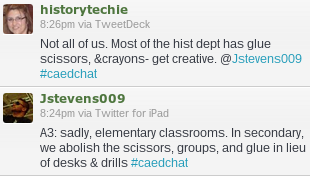
Along comes #caedchat on Twitter. (Every Sunday night at 8:00 pst) The topic this week was innovation in the classroom. You can imagine my surprise when the topic of scissors and glue came up. Innovation, scissors, and glue are just three things that I never thought of as going together. But this exchange got me to thinking:
I always tell people its not just about the tech. I tell them not to just add tech for the sake of the technology, but to view it as a tool. But I have been dismissing the use of scissors and glue as low tech, and not worthy of high school. When I stop and think of some of the conversations I have recently had with people about entreprenuralism, prototyping, maker faire and the like I realize there may be room for scissors AND glue in the high school classroom.
Its not the tool, its what you do with it that makes innovation.
I have committed this year to do a better job of providing timely feedback for my students. I know that timely feedback is what makes or breaks a learning experience. When I was a child learning to ride a bike, I knew immediately when I made a mistake. I knew because I crashed and it hurt. I knew when I was doing it right because I didn’t crash, and it was fun. When I read about using games in the classroom I find that they are valuable because the feedback is immediate; the student doesn’t need to wait to get their paper back to see how they did. They know right away; they got points, they lost points, or they got game over. And that, so the theory goes, is why games are so engaging.
The problem is the classes I have are not games. Or at least I haven’t figured out yet how to make them games. (Maybe I should learn to code…hmm.) I still am having kids “do things” and turn them in. And that is where the catch is. Right now there are 76 “things” in my cue awaiting feedback, or as my kids prefer, waiting to be graded. Some of those things are videos, some images, some websites, some short essays. To make the problem worse, I don’t penalize for late work (why I do this is another post) and students can redo work as many times as they like to get the grade they want. All this makes my inbox a mess. Some of the work is new and timely, other pieces are things that a student didn’t turn in a couple weeks ago, and still others are things I have already seen a time or two before.
So my challenge today is to figure out a way to tame the inbox so that kids get their feedback no later than the next day. They need to know when they are doing well and when they fall off the bike.
I just finished the coursework for a Preliminary Administrative Credential at Teachers College of San Joaquin. In California prospective administrators have two options to become credentialed; take a test or take a year long series of courses. The test takes a Saturday and has a relatively small fee. The coursework option is several thousand dollars and is just shy of a masters degree. Seemed like a no brainer to me- I took the coursework!
One of the ideas that kept gnawing at me through all of the coursework was that it is a good thing to stay at a school for a short while and then move on. I was told that I should plan on being an Assistant Principal for three to five years and then move on to something else. And then repeat. It seems like the old football saying, “three and out.” The three and out thing is generally not a good one. Unless you are on defense. I don’t think schools should play defense.
One of the things that make good schools effective learning places is the environment. Effective schools have a positive climate where everyone feels included. Students, staff, teachers, parents and all the stakeholders feel they have an important role in the school. I think of that as a sense of ownership. It is our school. As an administrator I think it would be difficult to accomplish this climate when your tenure is shorter than the tenure of the students. Especially in high school.
I think if we truly want to transform schools we have to be a part of the learning community. We as educators have to be a part of the community as much as the students and their families. We really are in this together. You can’t do that if you are going three and out.
I try to give my students choice. I don’t tell them how many slides their presentations have to have; I tell them they have to give a presentation, and I give them questions to answer. They usually choose PowerPoint first, because that is how they have been taught you do a presentation. Then they realize the group project would be lots easier if they built slides in their Google Drive, so they go in that direction. As I move around the room watching what they are doing I will mention occasionally that IF (lots of emphasis on ‘IF’) they are using slides they should be sure to not to have too many words on the slides. This usually causes a commotion in the groups, and the paragraphs are moved to speaker notes. I think “yea!”
A few kids pick up on the ‘if’ in the statement. “You mean we don’t have to do a PowerPoint?” I reply “Nope. I never said that. You have to present, how you do that is up to you.”
Then things get interesting. Most kids stick with the Google slides option, but a few kids will go into that other software; starts with a ‘P’, ends with an ‘i’ and has a ‘rez’ in the middle. The kids love it. I get sea sick easily, and am not so much of a fan. A poor PowerPoint beats a poor Prezi any day.
So today some kids were working on a Prezi. So I said it. “Do you guys know how much I hate Prezi?”
“Yea, Mr. Hall, we know. But you don’t get to choose, we do. We have a plan. So don’t you have something else to do, we’re busy over here.”
I love that not only are my students picking their tools based on what they want to accomplish, but they have the confidence to tell me they are right, and to go away. Its going to be a fun year!
The first day of school this year absolutely wiped me out. I was exhausted. I didn’t understand why the kids were so worked up. Some periods I was having a really hard time keeping the kids’ attention. I didn’t get it. I thought I was loosing my touch. I don’t have days like this, especially not on the first day of school.
I talked to other teachers, and they had the same experience. The kids were really wound up, and having a hard time sitting still. And then I realized that it wasn’t the kids who were different, I was different. We have a new Principal this year, and I was concerned that I do everything the right way, by the book. So I planned go over the class rules, go over the course outline, go over the expectations, you know- all that boring first day stuff. That was the problem. We were all doing the boring first day stuff. Of course the kids were all wound up, we were asking them to sit still in these absurd plastic chairs (except for my room, were they have nice padded rolling chairs) while we talked at them. Well I talked at them anyway. And that was the problem, I was so concerned about doing it “the right way” I forgot that I don’t ever do it “the right way.”
Over the summer I had the opportunity to see a keynote by @fitzwalsh and then talk to him afterwards about my plans for the year. He introduced me to the idea that talking was the enemy of do. If we want our kid to do, then we need to stop talking about it, and well, do it. I was all excited about the new year, and how it was going to be all about DO. And how did I start? I talked. I fell into the trap. I went the traditional way. I talked. A lot. And it sucked.
The participants of the CUE Rockstar Teacher Camp aboard the USS Hornet. One of several amazing edtech events I attended this summer. (Photo from http://www.rockstartechcamp.com/)
I just came home from my last professional development of the summer. Today was the first ever EdCamp San Joaquin. This was a free “un-conference” that was sponsored by the Teachers College of San Joaquin and Central California CUE. The event, like all edcamps was free to the participants, and the program was decided upon by the participants themselves once they arrived. I had an amazing time learning all kinds of new things to try in class starting -ugh- next week!
Really the best part was that this was just one of several fantastic professional development events I attended this summer; CUE Rockstar Teacher Camp, Google Apps for Education California Summit, the Google GeoTeachers Conference and more. What did these all have in common? They were all attended by willing participants. No one (that I know of anyway) was “sent” to any of these events. They were all teachers, admins, and others who came out during the summer, on their own time, with the intention of improving their craft. And that willingness to give up their own time to learn something new really truly makes a difference.
So I want to thank all the people- those that I know and those that I do not know- who gave up time this summer and willingly, enthusiastically participated in or organized these events. You really make a difference. And to those who won’t give up your own time without getting paid? Well, you are just missing out, and so are your students.
Summer is here. Check out day has come and gone, but I haven’t checked out. I have been to school almost every day since school was out three weeks ago. Well except for the week I actually took a vacation. I don’t know how people walk away from campus for two months and not even think about their profession. I know I can’t.
First there is the debriefing. What went well last year and what do I need to focus on for the next year. Fortunately there was lots of good this year. My students got further and deeper into the curriculum than any of my students have before. I had very few discipline problems, and I found that my students were much more engaged than I have experienced in the past. These are the things I want to build on.
On the down side, I missed a lot of school. I was working on my administrative credential, which required I miss 20 days so that I could shadow an administrator on a different campus. It was a great experience, but it meant missing all of those days. On top of that I was pulled out of the classroom a number of times to work on different administrative tasks. Again, these were great learning experiences for me, but it came at a high cost. I really did not enjoy seeing kids on campus in the morning and have them ask me “Are you gonna be here today, or are you gonna be gone- again?” That question goes on my list of all time things that suck. While it sucked, it’s an easy fix!
Now I am thinking of things I can do to make my class even more engaging for kids. I arranged for some new software this year, which may or may not include Minecraft, and we now have a 3D printer in my room. I spent some time this last week setting up a photo studio in the empty room next door, which includes a green screen area. I still have piles of robot parts and remenants from ROV’s students built in the past that can be utilized by students. The biggest change I am considering is how to implement all of these things in a “Maker Space” kind of approach to the class. I have this vision of my high school students creating business plans for actual products they create. But I don’t know how to get there from here. That’s how I am spending my summer, trying to figure it all out.
As soon as the school year was over I started work on next year, because that is what good teachers do, and I hope to be a good teacher. On the last day with students I give them a survey to complete. It keeps them busy for the last period of the year doing something productive and it gives me input on what to change for next year. Most of the feedback I get from these surveys is fairly predictable. “I would do better in this class if I tried harder.” “This class would be better if we didn’t have to write so much.” But this year I got some feedback that surprised me a little bit. Some of the students, just a few, reported that I am too busy to help them. They said that I was too busy with my SkillsUSA students to pay any attention to them. They said they asked for help and I ignored them.
It bothers me that some of my students thought that I was too busy for them. Obviously I can not help everyone all the time, I am limited to being in one place at a time. But I really do not want kids to believe that someone else is more important than they are. My room is generally a noisy place, to some it may seem chaotic. And I do have a hearing problem, but still, students should never feel they are being ignored. Not in my class anyway.
This summer it will be a priority to figure out a back channel for my class so that this problem does not occur again. As it is students have access to 2 email addresses for me. They also have my Google Voice number if they want to text me. But still somehow kids were not able to get through to me. I am thinking about a new Twitter account just for the class. Lets see how that works.
The graduate school I attend has announced they are no longer providing iPads for their students. They gave two reasons; budget cuts, and they have observed students don’t use the iPads.
No one can deny the impact of budget cuts, the school is also no longer going to loan textbooks- students will have to buy their own books like most other schools. I get that choice, books are expensive and it is easy- and logical- to pass that cost on to the students.
The same is true with the iPad decision. They are expensive, and if there is no money in the budget, an expensive iPad would be a logical place to cut. But the observation that the students are not using the iPads is bothersome. I am one of those students who rarely uses the iPad. No one asked me why, but that has never stopped me from sharing before!
Part of the reason I chose this particular school is because they gave out iPads. Not that I needed or wanted another one. But I thought that if the school was progressive enough to provide an iPad they would be using technology in innovative ways, and I wanted to learn more innovative approaches. I was wrong, not much innovation here.
As a student I am expected to turn in papers in APA style. Using an iPad to type a several page APA formatted paper is not the most efficient use of tools or time. In one class papers were required to be done in Microsoft Word! Why would I even look for the iPad if I am required to use Word?
We were expected to create a portfolio to document our learning. I am a huge proponent of portfolios, I have required my students to have portfolios for years. But I was being required to use a binder for my portfolio. Not a Livebinder, a binder. A binder full of word processed, printed, two dimensional pages.
English: D-ring type 3 ring binder (opened) (Photo credit: Wikipedia)binder full of word processed papers. I required my students to stop using three ring binders five years ago. But the school that gives you an iPad still requires a three ring binder.
I was required to make PowerPoint presentations. Not just any presentations, PowerPoints. And to print them out. Emailing assignments is frowned upon, they needed to be printed. Once, only once, was I expected to create a video. And I was told to not bother editing it, that was considered a waste of time.
So why did the iPad initiative fail? Because just giving out an innovative tool does not make an innovative program. If you really wanted me to use the iPad ask me, no LET me, do something the iPad is good at! And there is no shortage of things the iPad is good at. Don’t give me the same assignments colleges have been handing out for decades and expect to be innovative. Instead of asking me to make a PowerPoint presentation with handouts on flipped instruction, have me create a flipped staff meeting. The iPads would rock at that. Instead of asking me to make a three ring binder portfolio have me make a multimedia infused online digital portfolio. Again, iPads rock at that. Instead of an APA paper, why not a blog entry. Or a video. Or an animation. Or a Voicethread. Or you get the idea.
So I guess my point is that just handing out an innovative tool doesn’t make something innovative. You have to actually try something different for innovation to happen. But I guess that is not a very new idea either.
Last weekend I was lurking in another Twitter chat. This time it was #CAedchat, a weekly chat that happens Sunday nights at 8:00 PM. Many educators I highly respect participate in it. This particular evening the topic was gaming in the classroom, something I have no experience in, so I didn’t have a lot to say. So I lurked. I really don’t get the whole gaming in the classroom thing. I had Oregon Trail in my first computer lab. Then there was Sim City. I didn’t get it then, and I still don’t get it. I am not trying to be critical here of those who do use games. But I think when someone asks me why I am using a tool in the classroom I need to be able to give a good reason why I am using that tool. With games I can’t do that. But I know its just me. On Tuesday our school was doing state testing. I had some of the kids who did not have a test to take, so we had some time. One said to me “Mr. Hall you should get Minecraft up in here.” So I gave him a challenge: convince me why, from an educational perspective, I need to put Minecraft in my class. The next three hours my room was busy with students doing research on the topic. Kids were debating which points were most important and which would not convince me. They had notes. They argued over who should make the case. They found an unblocked way to run Minecraft to give me a demo. They were engaged. At the same time I turned to Twitter to find someone who could convince me. It started a whole new dynamic with my students trying to find things before I found them on Twitter. It was a lot of fun, and the kids made some strong arguments, but it was Stephen Elford ( @eduelfie ) chiming in from Victoria, Australia who won the argument. Once I figure out how to pay for it mine will be among the classrooms using Minecraft for students to create things. Give me a few weeks.



 The participants of the CUE Rockstar Teacher Camp aboard the USS Hornet. One of several amazing edtech events I attended this summer. (Photo from


 wmarkhall