Back when I was in the classroom I was approached by someone in our district who wanted me to submit some of my students’ artwork in a public showing. Normally I would be all over an opportunity like this. But this time the timing was all wrong. Much of the students’ best work was already on display at a local museum and so would not be available. Our open house was the same day as the deadline to submit work and I need to be sure the open house was strong. And to top it off, many students were in the final stages of preparing for the SkillsUSA California Championships. I did not need another thing on my plate. But I did not want to alienate the district person either. What to do?
I turned it over to the students. I told them about the opportunity. I did not give them an assignment. I did not give them requirements. I didn’t tell them what they had to do. I told them what they could do if they wanted. It turned out they wanted to. Many students went the extra mile to produce pieces for the district event. Of course they did. They had spent the year experiencing success- public success- by doing the kinds of things they wanted to do, as opposed to doing the silly useless tasks I used to assign that nobody wanted to do. Including me. Giving kids a voice really brings out the best in them.
“This kid stood up and told my wife F*#@& you right to her face in front of me and that kid didn’t even get suspended.”
“Classrooms are wild these days. Kids are so out of control, it didn’t use to be like this. And the Principal never suspends anybody, that’s why it is so out of control. All these out of town kids moving in.”
“This administrator is always undermining teachers. I don’t know what it takes to get suspended at this school.”
I have heard these kinds of comments my whole career. They seem to be more frequent lately. Perhaps it is because of public pressure, including legislation, to school districts to reduce suspension rates. How can you teach a kid if the kid is not in school? I think this pressure is a good thing.
In my career working in inner-city schools, I have worked with a lot of kids with disruptive behaviors. I have seen many kids kicked out of class for being disruptive, aggressive, or disrespectful. I will admit to kicking a few kids out for these things myself, especially in my early career when I didn’t know any better. Removing the student from the classroom never solved the problem. Sure, the immediate issue was gone; the outbursts were gone for the day, or for a few minutes, but the problem was not corrected. Usually, the problem was not even addressed.
I have found that when kids lash out in class it is a result of some combination of two reasons:
Something bad (often horrible) is happening in that student’s life or environment and the student does not have the ability to deal with it in a healthy way.
The teacher has not been as skillful in their craft as they could be.
In either case suspending the student will not solve the problem. Sending the student home means the student misses instruction and falls even further behind. When the student returns, nothing has changed. Rinse, lather, repeat.
As teachers, we can not solve all of the world’s problems. We are not psychologists. We are not social workers. We are not law enforcement officers. We are educators. Our job is to educate all of the kids that are enrolled in our classes. In order to do our job, we need to have a healthy supportive relationship with every student in the room. Kids need to feel safe in the classroom. A person can’t learn at an optimum level if they do not feel safe and supported. I have found that when a positive supportive climate exists those disruptive students magically go away. They are replaced with students that want to be in class. If they are in class they can be taught. If the student feels supported then those other issues of terrible, awful, very bad things happening in their life can be addressed. It all begins with a positive healthy relationship between the teacher and the students. All of the students.
A colleague of mine recently gave a talk about this that can be found here. (Warning: tissues may be needed.) If you are one of those teachers struggling with disrespectful kids, ask yourself about those relationships. Have you done the work to develop those relationships? It is never too late to work on it.
When I started my current position one of the projects being worked on was a redesign of the district science fair. It seemed everyone was frustrated with the status quo- a collection of cardboard tri-folds and volcano models. Not much had changed in decades, and no one felt it was a good example of what our kids are capable of. An emphasis seemed to be placed on quantity over quality. I joined the team and we all started coming up with ideas of what an engaging science fair could look like. We took a field trip to the Google Science Fair in Mountain View, CA. It was amazing. It was what we want our kids to do.
To get rid of the cardboard tri-folds we need to change the mindset, so we started with the name. Everyone knew what to do for the “old” science fair: the same thing they did last year and the year before. So the Science Fair became the Science and Engineering Expo. No one knew what to do- they had never heard of one! Including us. We needed to figure this out. We would have a number of “events.” The science exploration event would consist of individuals or teams of students (depending on age) presenting their science exploration, similar to what we saw in Mountain View. Kids would submit a digital presentation rather than the traditional cardboard product. They would then bring artifacts of their project, and present to judges and whoever else happened to be there to watch.
We built the day around 4 sessions, each with up to 10 presentations. The young scientists would come in and set up their work in a relaxed, casual atmosphere, and deliver their presentations to judges and whoever else happened by and was interested. Each student repeated their presentation 3 or 4 times, each time to a different audience. Then, after an hour or so, those students would pack up and the next group would come in. It was fun to watch the students revise and improve their presentations with each retelling. Even in their final presentation they were refining their learning. It was amazing.
In addition to the science presentations, we had a Minecraft challenge, our first ever Vex Robotics demonstration, and even a paper airplane competition. One of the comprehensive high schools sent a student video crew to record the day. It was fun to see these kids interact with the competitors. Just like the world of work! And another school had their CTE kids use a laser cutter to make awesome awards!
It was a huge success. The kids were amazing. The projects were wonderful. There was only one cardboard trifold, and it disappeared quickly! Kids talked about their learning, and it was genuine learning, not memorized stuff, or stuff copied from a book! Mission accomplished! In the words of one of the judges, “This was amazing. It was a science teacher’s dream. I am so glad I participated!” Or the words of one of the younger scientists “This is the best day in my whole life!” OK, she is only 8, but still.
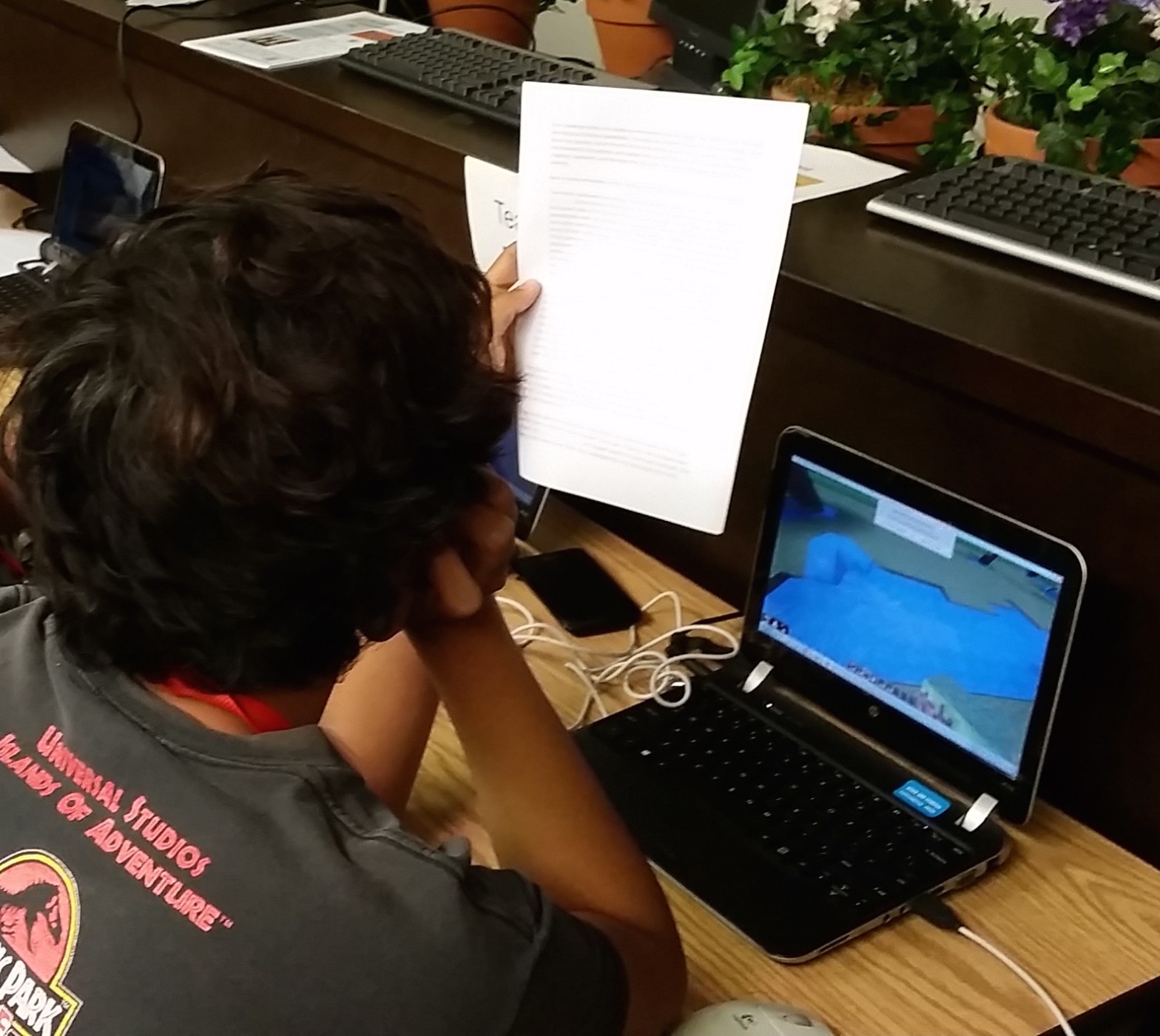
Today my district ditched the Science Fair. We turned it into the Science and Engineering Expo. It was a blast. It took a whole crew of people to pull off, and it was a huge success. The part I was most involved in though was what we called Top Chef: Minecraft Edition, with a tip of the hat to Jon Corippo for the Top Chef idea. The idea was kids would work in groups of three to create an environment in Minecraft that would support the fictional “Pacific Northwest Tree Octopus.” Every now and then in the two-hour event a new “secret ingredient” was to be announced that teams needed to add to their environment in a meaningful way. It was a great idea, but I had no idea how to actually pull it off. I have dabbled in Minecraft, but I don’t even rate the novice level. I am a total newb.
I turned to social media, and my friend Diane Main connected me with Shane Asselstine, in Hawaii, who provided us with the perfect Minecraft world to work in. One of the tech guys in the office, Darin, built a Lynux server for the event and repurposed some old laptops. He actually knew what to do with the world that Shane provided us! On the day of the event we had 7 teams of three kids each, and a whole big cheering section of family, friends, and teachers for each team. It was a whole thing!
I started to explain the event to the crowd; what the world was and how it worked when I was interrupted.
“Each block is 1-meter square. You should not say the area is 100 blocks by 150 blocks. You should say it is 100 meters by 150 meters.”
And that is how we started our first ever Minecraft Showcase, me being schooled by a 6th grader.
I corrected myself and continued explaining how the Minecraft challenge was going to work. To be honest, I had no idea how it was going to work, I was just hoping it didn’t end in disaster. It didn’t.
The first “Secret Ingredient” was an easy one: sand. I noticed that everyone had a lot of water in their area, and figured they would put the sand along the edges of the water, but I would trip them up by asking them WHY they put the sand there. The first time I did, the kid looked at me like I was a total scientific newb, and gave me my second schooling of the day “Sand is eroded rock. That is what it is. It flows into rivers and is deposited on the banks. It’s what sand does. That is where it goes. It’s natural.”
Excuse me.
One of the high school video crew suggested the second secret ingredient: paintings. How was a bunch of middle schoolers going to use paintings in an environment for the tree octopus in a meaningful way? No problem.
The first group put their paintings in a cave. You know cave paintings. Since the tree octopus prefers to hang out in caves, this team had a cave from “an ancient civilization whose population had mysteriously disappeared. These paintings are artifacts from that civilization” the 8th grader told me. That led to the discussion about the fallen tree that was just outside the cave. It was decomposing, providing a home for the frogs. Then they discussed the water lilies that attract the insects that the frogs eat. Because, you know, the tree octopus eats frogs. It said so right in the middle of the two solid pages of small text that I had given them explaining the tree octopus. You can’t have a tree octopus without frogs to eat, and you can’t have frogs without insects to eat. You see, they actually read the material. All of it. Then they discussed it among themselves. And made a plan.
We all know about maps, right? You know, Google Maps. We all use Maps to figure out how to get somewhere, what’s the best route, or how long it will take. I remember that first time, at a Cue Conference, when a collegue showed me that if you type “nearby pizza” into Google on a phone, you would get a map to a nearby pizza place! I have been hooked ever since. But do you use Google Maps in the classroom?
Last week I was working with some high school Social Science teachers in a professional development session on integrating technology into the classroom. The subject of Maps came up. “Why would you use Google Maps in the classroom? Where is the curricular standard in finding the quickest route to San Jose?” The teacher raised a legitimate question.
I had a simple answer. Social Science teachers are concerned with events that happened in the past. Every event that ever occurred, since the beginning of time, happened someplace. Every event had a location, and that location can be displayed on a map. And maps that show where events occurred tell stories. Why not have kids write these stories, collaboratively? Why not have kids share these maps with each other and the world? When kids make their own maps of events they can then see trends and relationships between the events, acquiring a deeper understanding of the events, and having an opportunity to write also!
We then spent some time collaboratively building some maps. We started with a Google sheet. Whoa there Mr. Hall you may say, I thought you said maps, now you are talking about spreadsheets! Yeah, we built a spreadsheet, one column was the name of a WWI event, the next column had the coordinates of that event, and the third contained a description of the event. This is where the students do their writing. Directly in the spreadsheet. All of the teachers were writing in the spreadsheet at the same time. It worked wonderfully. Then I imported the spreadsheet into Maps, and boom, we had a map!
I can’t wait to see the maps these teachers students create!
This last week I was invited to attend some presentations in one of our elementary schools. The invitation was an opportunity to go and see how technology is being used in schools. On Tuesday morning I made my way over to the Primary Years Academy, pushed my way through a crowd of proud parents outside Ms. Matty’s first grade class, and was amazed. Kids were grouped around their little tables, in teams of two or three. Each table had a bunch of props representing aspects of the country the kids had researched. The kids were in costumes, respectfully representing the traditional clothing of that culture. Each team had a Chromebook the kids were going to use for their presentations. They were getting ready.
As the kids were getting logged in to the Chromebooks, the problems started. Something had changed on the network the night before, and kids were presented with a screen they had never seen before. They didn’t know what to do. With a crowd of parents outside the room waiting to get in, and Ms. Matty busy with all the details involved in a day like this, I watched a boy and girl interact:
“Hmmm, That’s not right” the boy said.
“Try clicking here.” said the little girl.
“That didn’t work. I’m going to log out and try again.”
This went on for a few minutes before word spread among the kids on how to solve the problem. It was really impressive. Remember, these were first graders! Six year old kids! They had run into an unexpected problem, and were doing a fantastic job of problem solving. The kids solved the problem, and went on and gave their presentations to a room full of parents, and then repeated the performance for classes of older kids.
The kids did a great job. I saw really wonderful presentations. Kids were using technology in an authentic way, blended with realia to make a meaningful learning experience. I just wish everyone could see what is happening in Ms. Matty’s room. Great things are happening in that class. Ms. Matty is my Edu-hero.
Now that I have been in my new job for a half of a year, it is time to start getting back to the blog. One of the things that bothered me about being a classroom teacher was the isolation. A teacher never gets to go out and see what other teachers are doing. Sure you can go to conferences – I did that often- but that is not the same as going to other schools and seeing what is actually happening, what are teachers doing, and what are kids doing. So it is really difficult to have a sense of where you are at in the bigger picture. I thought I was a rather innovative teacher, but really, I had no idea. I had nothing to compare what I was doing with.
Now that I am out of the classroom I have the opportunity to go and see what is happening in the schools throughout the district. With some 2,000 teachers spread out over 53 schools I have some opportunities in front of me. I have seen some cool stuff so far. I loved seeing some second graders using Google Slides to give a career awareness presentation. It was a blast watching some 8th grade kids work on building a prosthetic arm. I got to see a bunch of high school kids pound on the door to get back into school – on a Friday afternoon, on a holiday weekend! They had work they wanted to get done. It wasn’t “due.” They just wanted to work. They didn’t see how school being over had anything to do with it. They wanted the dang door unlocked.
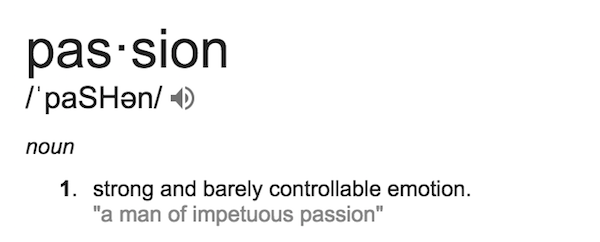
In reflecting back on these experiences, there was a common element in all of these, and it was the teacher. In all of these experiences, the responsible teacher was visibly passionate about what his or her students were doing. In thinking back on what I know about learning, what we know about high performing- high poverty schools, it is the role of the teacher that is most important. The teacher must believe in the kids; they must be passionate about the kids and learning. They must do whatever it takes to bring an interesting and engaging lesson to the kids. When this is done, the kids respond. They pound on the doors to get them open.
I am looking forward to seeing more passionate teachers, and helping others to rekindle their passion.
This last week our school held our first-ever open house, followed the next day by our expo. The open house was an opportunity for people in the neighborhood to come see what our students have been doing. Really it was a recruiting event; we are a school of choice, no one comes to our school because they have to, they come by choice. We need to recruit students so that we can pay the bills. By showing kids what our students actually do those that are interested in doing that will come.
The second event, the Merlo Expo, is an opportunity for our students to share their work with local business and industry leaders, and for those leaders to provide feedback to the students. The local Chamber of Commerce recruits volunteers to come hear the student presentations. This year we had about twenty-five volunteers come and work with our students and leave them with written feedback on their projects. It was amazing.
In looking through the feedback, a common theme emerged, this one from Facebook-
Wow. Just attended the Merlo Expo as students prepare for the SkillsUSA State Conference next weekend and wow! I saw some amazing projects and project management skills that would put these young leaders in jobs in a heart beat! -Jonathan Buyco
Project management was a common theme. The business people consistently said that the students demonstrated great project management skills, and how important that is. It was a little eye opening because I had never thought of that as a goal. We talk about time management, but that is a different thing. There were no comments about time management, which is a standard we specifically address. Folks were talking about project management.
A photo posted by Merlo Institute (@merloiet) on Apr 3, 2015 at 8:35am PDT
These projects are all different. They are all student-designed projects that came from the question “What are you passionate about?” I couldn’t possibly manage all of these projects. One group published a book about Ballet Folklorico, and another built an underwater robot. One group published three children’s books, and another created a “Little Free Library” for the school.I could not manage these, there is not enough time in a day, nor do I know much about these topics. They needed to manage the projects. I need to remind them that is a job skill they have. In the future I need to be sure all of my students develop these skills and know it!
This year I am taking on the #youredustory blogging challenge. The short version is one blog posting a week about a suggested topic. Or you can use your own topic, just share once a week. Oh, and comment on other peoples’ posts. Sounds like something I can handle, so here goes!
The topic this week is “What is your “one word” that will inspire you in your classroom or school in 2015?.” That for me is easy. My one word is “Do.” As in do something. Just do it. Or, as Yoda said, “Do or do not, there is no try.” (I think that is what Yoda said, I am not a sci-fi kind of guy at all.)
Too often I find I think about the thngs I might try, or I should try, or I am going to think about. I find my to-do list getting longer and longer. I find I am always encouraging my students to do something, or make something, but that advise does not always come back to me. I need to change that.
Recently I came across a blog posting where it was argued if someone is going to teach a subject they need to be a practitioner of that subject. (Sorry, I can’t remember whose blog it was- I am sure I will be reminded shortly!) If someone teaches English, they should be a writer; if they teach welding they should be a welder. I think that is true. So this year, when I give an assignment, I am going to do it too. With the students, in front of the students. I am going to do.
One of the things that I have noticed changing in class recently is the student response to a new project. In the past I would hear a lot of “but I don’t know how to do that” as an excuse for why a student was participating. There were a lot of versions of the same thing; “I am not good a computers,” “I am not creative,” “why can’t you just give us a work sheet?” But that has changed this year, for the better. Now, when a new assignment is given, more often than not I get a “Hmmm.” And a long pause. And then, eventually, “I know what I am going to try…”
Part of the change is because I stopped giving grades for assignments. I still have to put a grade on a report card, but instead of a grade on an assignment I put comments and I ask questions. I encourage them to try again. And again. And I spend a lot of time talking with kids about their work. In fact, I spend almost all of my class time now talking with individual kids about their work. Those individual conversations have changed everything. Now I think the students feel safe to try something they don’t know how to do. It is OK to try over and over until they understand the concept, and they aren’t going to fail the class because of it.
I always thought the “I don’t know how to do that” comments were odd. Of course they don’t know how. Why would I ask my students to do something they already know how to do? This is school! We are here to learn new stuff, and how to do new stuff! I think we have trained kids to “do school” instead of learn at school. I think it is the result of ten years or pacing guides and workbooks. Find the answers. Fill in the blanks. Copy and paste. Copy the notes from the PowerPoint. We lost the learn. We stopped creating. We kicked “I wonder” out of class. Lets bring those things back.





 wmarkhall